
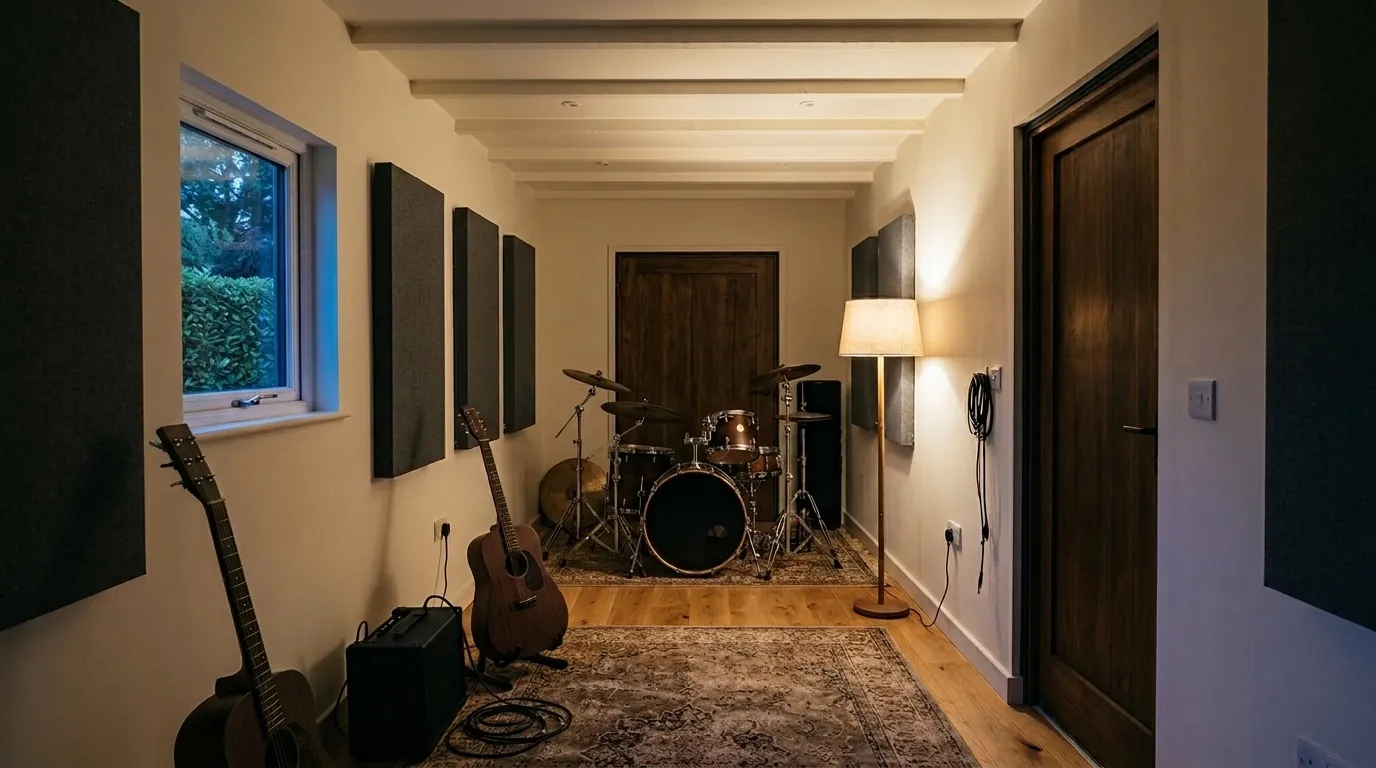
Short answer: to stop sound getting out of a garden room you need weight, a gap and an airtight seal: heavy boards, an inner frame that does not touch the outer wall, and no air leaks, with the door and the floor treated as seriously as the walls. Foam panels only change how the room sounds inside. CS Containers in Bexleyheath, Kent, builds container music rooms this way.
Most soundproofing advice online is really about acoustics, which is a different problem. This guide explains the difference, what actually stops sound escaping, why drums and bass are the hard part, and what a steel container does well and badly for this job. Updated October 2026.
What is the difference between soundproofing and acoustic treatment?
Soundproofing, which builders call sound insulation, stops sound passing through the walls, roof, floor and door. It is what keeps the neighbours on side. Acoustic treatment changes how the room sounds inside: panels and foam absorb reflections so a drum kit or a voice does not ring and echo.
They need different things. Foam and fabric panels are light and soft, which is right for treatment and almost useless for stopping sound escaping. A music room usually needs both, but in that order: build it to keep the sound in, then treat it so it sounds good.
What actually stops sound getting out?
Three things, and a good build gets all three right.
1. Weight
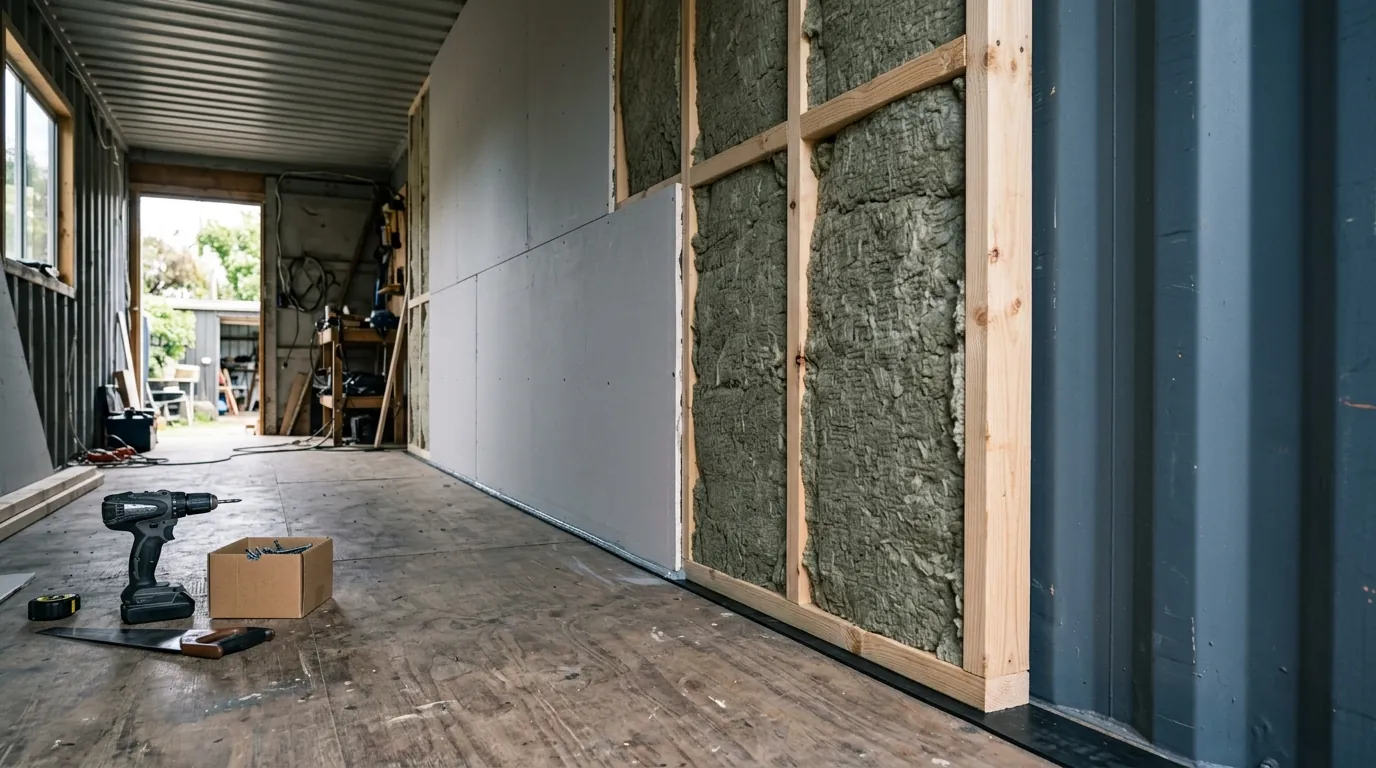
Heavy walls stop more sound. In theory every doubling of a wall's weight stops about 6 decibels more, and that rule works worst at low bass. In practice the weight comes from dense boards: a single sheet of 15mm acoustic plasterboard weighs at least 13.6kg per square metre, and studio walls usually use two layers with the joints staggered.
2. A gap
An inner wall that does not touch the outer one stops far more than the same weight fixed solid. Acoustic engineers find a well-built cavity wall does 5 to 10 decibels better than a solid wall of the same weight. The best version is a room within a room: a separate frame for the walls and ceiling, standing on its own floor, with no solid path for sound to travel along. Mineral wool goes in the gap, where it soaks up sound bouncing between the two walls. It does not add weight, which is why it does the job only alongside the boards, never instead of them.
3. No air leaks
Sound goes wherever air can. A gap round a socket, a pipe or the edge of a board lets out far more than its size suggests: acoustic consultants find that an opening of less than 1% of a wall's area can undo a large part of what a good wall achieves. Every joint is sealed, and the inner room is airtight.
Why are drums and bass the hardest to keep in?
Low notes carry the most energy and pass through light walls most easily, which is exactly where the weight rule is weakest. Drums add a second problem: a kick drum pushes energy straight into the floor through the pedal and the stands, and it travels through the structure rather than the air.
That is what a floating floor is for. It sits on a resilient layer, so the energy is not passed into the base and out into the ground. Screws or concrete that bridge that layer undo it, so it has to be built carefully. If you play drums or bass, plan the floor from the start rather than adding it later.
Where does sound leak out of a garden room?
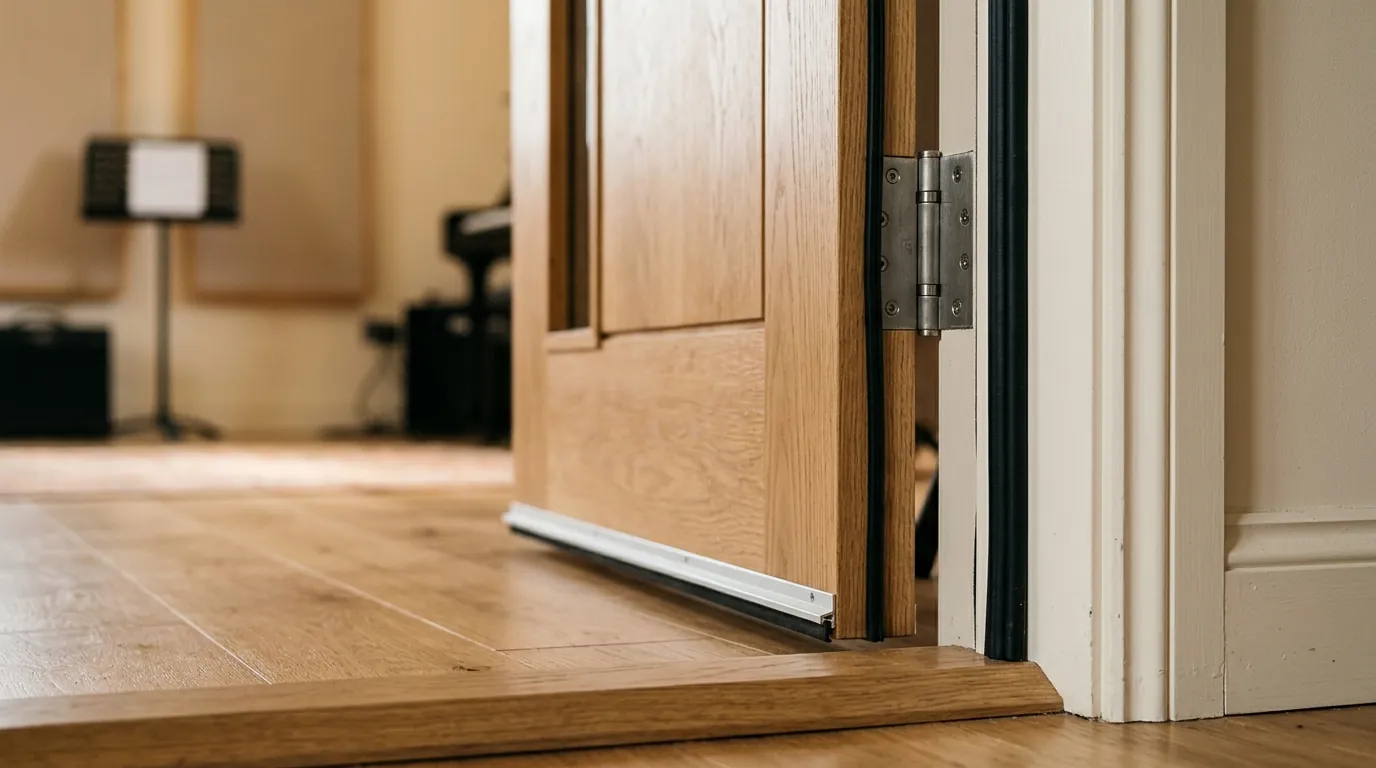
The door, first. A door is lighter than the wall round it and it has a gap all the way round. A studio door is solid and heavy, with compression seals on the frame and a drop seal that closes the gap at the bottom when it shuts. Two doors with a small space between them, an airlock, is better again.
Windows next. Any window must close airtight, and double glazing does much better than single. Fewer and smaller windows make the job easier.
Then the air vents. A sealed room still needs fresh air, and a plain vent is a hole in the wall. The answer is an acoustic baffle: the air takes a lined, zig-zag route through a box, so it gets in and out but the sound loses most of its energy on the way.
Is a steel container good for soundproofing?
A container helps in one big way. It is already a sealed, rigid, weatherproof steel box, and the whole room inside it can be built in a workshop, so every frame, seal and joint gets done under cover before it arrives, not in the garden in the rain. It also stands apart from the house, with no shared wall for sound to travel through.
Its weakness is the steel itself, which is thin. A container's side wall is corrugated steel about 1.6mm thick, which works out at roughly 13kg per square metre, about the same as one sheet of acoustic plasterboard and around a twenty-eighth of a plastered brick wall. Thin steel also rings when it is hit. So almost all of the soundproofing has to come from the room built inside it, and the container's width, about 2.35m inside, limits how thick those inner walls can be. Plan the layout with that in mind.
One more thing to get right: sealing and insulating a steel box can trap moisture. A vapour control layer on the warm side of the insulation stops condensation forming inside the wall. Our guide to why containers get condensation explains it, and how a container is insulated covers the build.
Will the neighbours hear it?
Nobody can honestly promise they will hear nothing. It depends on what you play, how loud, how late, how far away they are and how well the room is built. A practice room for guitar and vocals is a very different job from a room for a full drum kit at night.
It is worth getting right. In England a council must investigate a complaint about noise from a property, and if it decides the noise is a statutory nuisance under the Environmental Protection Act 1990, it has to serve an abatement notice. If you need guaranteed figures, for a professional recording studio for example, bring in an acoustic consultant before the specification is fixed.
How does CS Containers build a container music room?
Phil Cambridge builds each one to the customer's specification in the workshop and delivers it finished by HIAB crane lorry. The standard build has mineral wool insulation in the wall cavity, an acoustic lining, ventilation with acoustic baffles, power, lighting and a lockable door. For drums and bass the options are a floating floor, a double-door airlock and deeper wall linings, and a 40ft container can be split into a control room and a live room. Phil is not an acoustic engineer and says so: for a home practice room or rehearsal space his builds work well, and for a professional studio with set targets he recommends a consultant.
Every music room is priced to its specification. See container music studios for what goes into one, or call Phil on 020 8226 0007. Tell him what you play, how loud and when, and how close the nearest house is, and he will price the build that suits it.
Sources: Approved Document E, resistance to the passage of sound; Sound On Sound, soundproofing and acoustic treatment; Sound On Sound, building a shipping container studio; Environmental Protection Act 1990, section 79; GOV.UK, how councils deal with noise complaints; Planning Portal, building regulations for outbuildings.