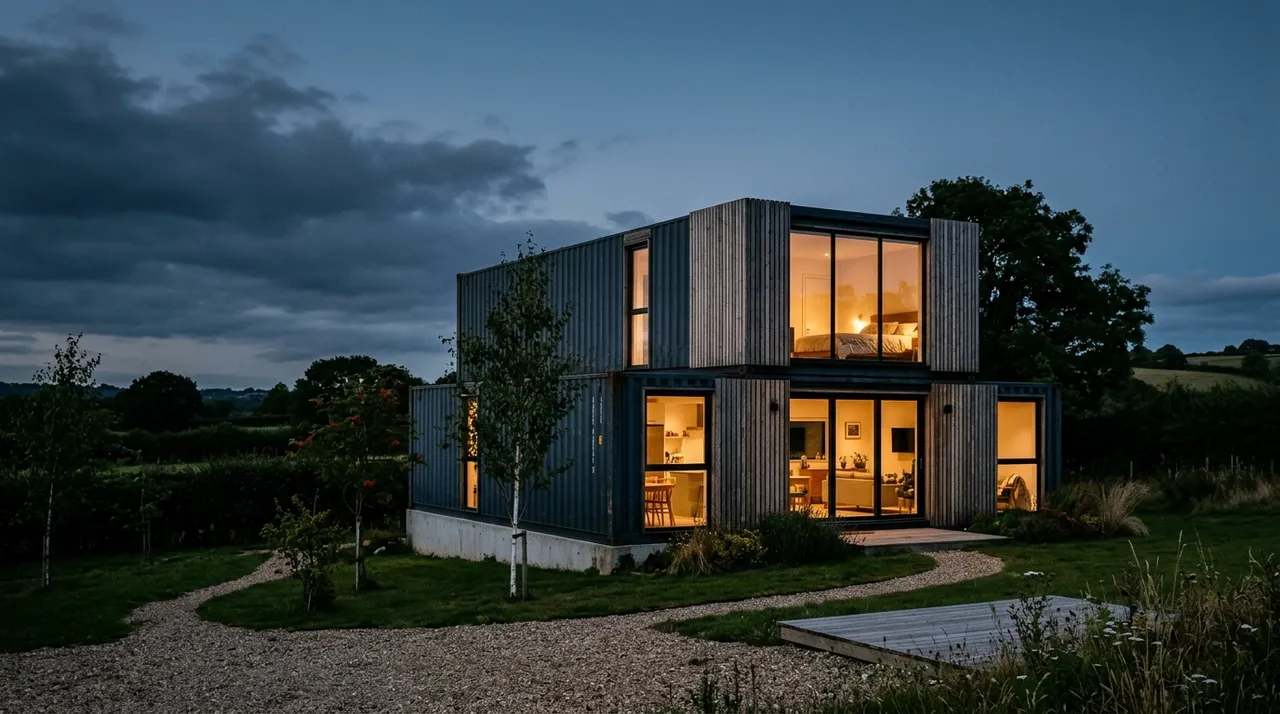
The container element of your self-build — supplied, insulated and fitted to your architect's spec, then delivered UK-wide by HIAB. Honest advice from 30+ years in the trade.
A shipping container home is a house built from one or more steel containers, converted to a habitable standard. In the UK it needs full planning permission and building regulations approval — there's no shortcut. Phil supplies and converts the container element to your architect's specification and delivers it by HIAB; he works alongside your self-build team rather than running the whole project.
A shipping container home is a permanent dwelling built from one or more steel shipping containers. The containers form the structural shell; the home is created by insulating them, lining them out, cutting in windows and doors, fitting electrics and plumbing, and joining or stacking units to make the floor plan you want. The result can be anything from a compact one-bedroom studio to a large multi-container family house.
Most of what you'll see online is from the US or Australia, where the planning system is very different from England, Scotland and Wales. In the UK a container home is a legitimate build — but it's a proper construction project, not a shortcut to cheap housing. It needs land with residential planning permission, an architect or structural engineer, building regulations sign-off, and certified trades for the electrics, plumbing and groundworks.
What turns a steel box into a home you can legally live in is the conversion: a calculated insulation build-up in the walls, floor and roof to meet Part L energy standards; controlled ventilation to manage condensation; fire-safe construction; certified wiring; and proper glazing. That's the part Phil builds — the container element, fitted to your architect's specification.
Single or multiple containers? A single 40ft high cube makes a workable studio or one-bed annexe. Most family-sized container homes join two, three or more containers side by side or stack them over two storeys — your architect designs the layout, and Phil converts and delivers the units to suit it.
Container homes are built up from standard container sizes. The bigger the home, the more containers — joined side by side for width, or stacked for a second storey. Here's roughly what each starting point gives you.
A single container as a studio, garden annexe, or home office with washroom. A 40ft high cube gives roughly 28m² — enough for an open-plan room, kitchenette and shower room.
Two or three 40ft units joined side by side open up into a one- or two-bedroom home with a proper living space, kitchen and bathroom. The most common UK container-home footprint.
Four or more containers, often stacked over two storeys, for a three-bed-plus house. This is firmly architect-and-engineer territory — the structural design has to account for the openings and the stacking.
High cube containers — with an extra 30cm of height — are the usual choice for homes, because once you lose headroom to floor and ceiling insulation, a standard container can feel low. See the container sizes guide for exact dimensions, or talk it through with your architect and Phil.
The honest answer is that it varies widely, and the container itself is the cheap part. A 20ft shipping container starts from £1,550 + VAT and a 40ft from £1,450 + VAT — but the shell is a small slice of the total bill. The bulk goes on the fit-out, insulation, glazing, services and trades. Here's roughly how a UK container-home budget breaks down:
| Cost element | Typical range |
|---|---|
| Container shell & conversion fit-out | £15,000–£50,000 |
| Architectural & structural engineering fees | £5,000–£15,000 |
| Planning application fee (England, single dwelling) | £578 |
| Building regulations fees | £1,000–£3,000 |
| Services (electric, water, drainage, gas) | £5,000–£20,000+ |
| Groundworks & foundations | £3,000–£10,000 |
Add land and landscaping on top, and total self-build container homes in the UK typically range from £60,000 to £200,000 or more, depending on land, specification and site conditions. Anyone quoting you a flat "container home from £X" without seeing your land and design isn't being straight with you.
Phil quotes on the container and conversion element only — the part he builds. The total project cost depends on many factors outside his scope, which is exactly why a container home is a self-build with a professional team, not an off-the-shelf product. For more detail, read the full container homes cost and planning guide.
This is the part people most often get wrong, so let's be clear: a container home in the UK always needs full planning permission. Living in a container is a change of use — from storage to permanent residential accommodation — and there is no permitted development route to a home you can live in as your main residence. Don't buy land assuming permission will follow.
Building regulations apply on top of planning. They cover structural integrity, fire safety, thermal performance (Part L insulation standards), ventilation, electrics, plumbing and drainage. A container home must meet the same building regulations as a traditionally built house — not a lower standard because it started life as a steel box.
Start by contacting your local planning authority for pre-application advice before spending money. Greenbelt land, conservation areas and areas of outstanding natural beauty all add complexity and time. A standard application takes 8–13 weeks; contentious sites take longer.
For the full picture, read our two detailed guides:
This page is for general information only and is not legal or planning advice. Planning rules and building regulations vary by location and individual project. Always consult a qualified planning consultant and structural engineer for your specific project. CS Containers does not provide planning advice.
Almost every UK container home is a self-build. You hold the project together, with a professional team around you. Phil is one part of that team — the container specialist — and he's straight about where his job starts and stops.
For those parts you'll need an architect or structural engineer, a building-control inspector, and certified electricians, plumbers and groundworkers. Phil works alongside them, converting and delivering the container component to the team's specification. That division of labour is what keeps a container home honest — and what stops it turning into the "expensive lesson" Phil has seen others learn the hard way.
Converted units are delivered across mainland UK by HIAB crane lorry and lifted directly onto your prepared foundations. The HIAB does the placing, so there's no second crane to hire. Delivery is included in Phil's quote, not bolted on afterwards. You'll need a level, firm base ready and clear access for the lorry and crane; Phil talks that through with you before delivery day.
"Container homes are doable and I've supplied containers for self-build projects. But I'd be doing you a disservice if I made it sound simple. Get an architect on board early, check with your local planning authority before you buy land, and treat the container as one component of a proper build project — not a shortcut to cheap housing. Done right, with the right professional team, a container home can be excellent. Done wrong, it's an expensive lesson."
Offices, classrooms, cafés, welfare units and more — built to your spec by Phil.
A fully fitted workspace — the most common conversion Phil builds.
From £1,450 + VAT. The usual starting point for a container home.
From £1,550 + VAT. Suits a compact studio or garden annexe.
No call centres. No fuss. One phone call.
Price it up yourself
Three taps and Phil has what he needs. No obligation, nothing charged here.
Or just ring Phil on 020 8226 0007 — he answers his own phone.
 Cambridge Containers Order Desk Ref QT-0000-0000 020 8226 0007 Call Phil